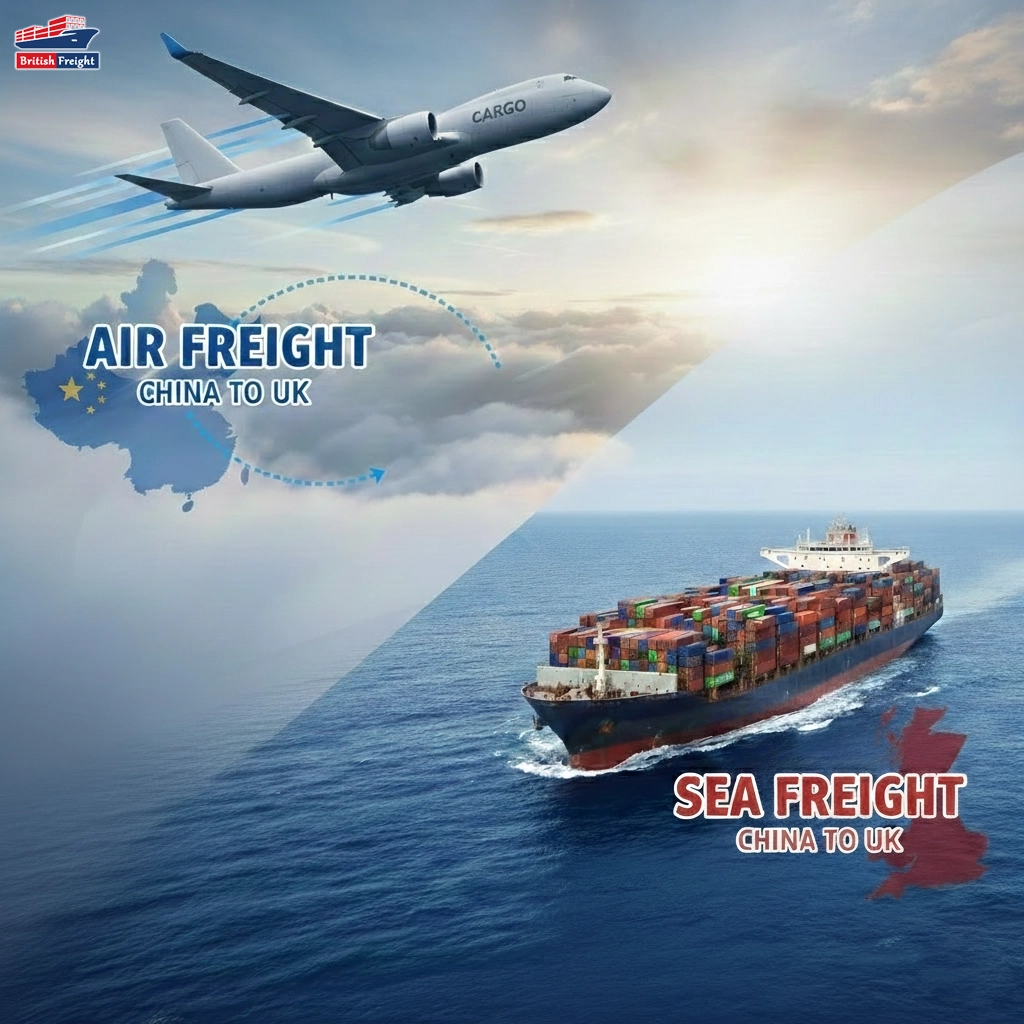
Air vs Sea Freight from China to the UK: Which One is Right for You?
Are you struggling to decide between air and sea freight shipping from China to UK?
When choosing a shipping method, factors such as cargo type, delivery deadlines, and budget are crucial.
Then this blog will guide you to the real differences in speed, cost, reliability, and use cases so you can choose the option for yourself.
Depending on your work or business scenario, both air and sea freight have some pros and cons. Air freight offers quick delivery for time-sensitive goods, while sea freight provides the lowest cost for bulk shipments.
China to UK Shipping Overview
It is so crucial to understand the main shipping methods, transit times, documentation, and key challenges involved in moving cargo from China to the UK.
Designing and implementing a strategic plan has become a necessity for importers, wholesalers, and e-commerce businesses. Along with rising competition and tight delivery schedules, choosing the right shipping method can directly impact profit margins and customer satisfaction.
There are some key elements that you must keep in mind for a stress-free container shipping China UK service:
- Clear understanding of the shipping process
- Plan cost and logistics
- Prepare essential documentation
- Select shipping method
- Measure transit time
As China to UK shipping is a key route in international freight and global business. Thousands of containers move between these two countries every month, supporting retail, manufacturing, and online trade.
Both countries follow strict compliance rules and customs regulations.
How Does Air Freight from China to the UK Work?
Air freight shipping might sound complex, but it’s actually quite hassle-free when handled by an experienced professional team.
The entire process begins with cargo preparation, labelling, and documentation, followed by pickup and airport handling in major Chinese cities. After export customs clearance, the shipment is loaded onto a commercial or cargo aircraft.
When the goods arrive in the UK, they go through customs inspection. A licensed freight agent manages paperwork and compliance to avoid delays. After clearance, the cargo is delivered to the buyer’s address, making air freight one of the fastest shipping methods for urgent and high-value goods.
This overall process involves the air cargo shipping process, variation of rates, and they have their own advantages and disadvantages. Let’s understand each one of them.
Air Cargo Shipping Process
The air cargo shipping process plays an essential role in global trade by offering unmatched speed and efficiency. It is a systematic process where every single step requires proactive arrangements and planning.
The process starts with shipment booking and documentation preparation. Cargo is then transported to the airport, inspected, and cleared for export customs. After loading onto the aircraft, the shipment is flown directly to its destination.
Air Freight Rates to the UK
The air freight rates to the UK are influenced by shipment weight, dimensions, destination airport, and service type.
Normally, the air cargo services are priced higher, while economy options provide cost savings for non-urgent shipments.
The seasonal demand, customs clearance fees, and fuel surcharges also affect final pricing in this regard.
Smart planning and proper cargo measurement can help keep costs under control.
Criteria of Sea Freight from China to the UK
If you are shipping in bulk or full containers, sea freight offers unmatched value. Cost efficiency remains a major reason companies choose this method.
The ocean freight China UK significantly reduces logistics expenses for large shipments. This process allows importers to stay competitive in the UK market.
Sea shipping usually takes three to six weeks. Businesses with flexible delivery schedules often prefer this option because it offers better cost control.
Durable products such as building materials, auto parts, and consumer goods are commonly shipped by sea.
Sea Cargo Shipping Process
The sea cargo shipping process involves several important stages that ensure goods move safely from the supplier to the buyer. It begins with booking space on a vessel through a freight forwarder or shipping line.
After booking, the cargo is packed, labelled, and moved to the origin port. Export documentation and customs clearance are completed before the container is approved for loading.
Benefits and Limitation of Sea Freight
Sea freight stands out for its reliability when transporting high-volume goods across continents. It provides strong cargo security, stable handling, and eco-friendly transportation compared to air freight. But on the other hand, it has some limitations as well.
Here we explain some of the points in both contexts.
(Benefits)
- Handles heavy and bulky cargo easily
- Saves money on large shipments
- Global shipping network
- Lower fuel cost per shipment
- Stable rates for bulk transport
- Environmentally responsible choice
(Limitation)
- Takes weeks, not days
- Unpredictable schedules
- Port delays increase the total cost
- Extra insurance is often needed
- More customs formalities
- Limited flexibility for urgent orders
Sea Freight Costs to the UK
Sea-freight-to-the-UK is a popular choice for businesses aiming to reduce logistics costs without sacrificing reliability. Prices vary based on shipment volume, container size, port charges UK, and transit time.
Other cost elements may include port handling fees, documentation charges, customs duties, and last-mile delivery within the UK. As the transit times are longer, sea freight remains the most affordable way to transport heavy or large shipments to the UK.
Air vs Sea Freight Transit Time Comparison
Air freight is the fastest shipping option for moving goods internationally, often taking 2 to 7 days from origin to destination.
In comparison, sea freight usually requires 25 to 45 days, depending on the route, port congestion, and customs clearance.
In the table below, we compare the transit time of major trading countries and the total number of days and weeks.
S.No: | Route | Air | Sea |
1 | China → USA | 3 days | 3–4 weeks |
2 | China → Europe | 5 days | 4 weeks |
3 | China → Middle East | 3 days | 2–3 weeks |
4 | Europe → USA | 3 days | 3–4 weeks |
5 | India → Europe | 5 days | 3–5 weeks |
Which Freight Method Is Cheaper from China to the UK?
Different freight methods charge differently according to their fee structure, volume, transit time, best for, approximate cost and distance.
Here we can analyse quickly multiple factors and various freight costs in the table below:
Quick Comparison (Cost Vs Speed)
S: No | Freight Method | Approx Cost | Transit Time | Best For |
1 | Sea Freight | Cheapest | 30-45days | Large and heavy shipments |
2 | Rail Freight | Mid-range | 18-25 days | Medium shipments |
3 | Air Freight | Expensive | 5-8 days | Time-critical goods |
4 | Express Courier | Highest per kg | 3-5 days | Small, urgent parcels |
Best Shipping Option for Different Business Needs
Choosing the right shipping method is a critical part of any business. FCL LCL shipping both can save time, reduce costs, and improve customer satisfaction. But the best shipping option depends on the type of business you run.
Let’s explore the ideal shipping methods for different business needs. A few of them are mentioned:
eCommerce Sellers: For eCommerce sellers, speed and reliability are the main elements. Customers expect fast delivery, order tracking, and safe packaging. The best options for them include: Express Air Freight, Courier Service, and Sea Freight for bulk inventory, etc.
Wholesale Importers: Wholesale importers handle large shipments, often in containers. Cost-efficiency and volume management are top priorities. The best options include: air pathways, Consolidated Container (LCL) Shipping and Full Container Load (FCL) Sea Freight, etc.
Manufacturing Companies: Manufacturers often require shipping for raw materials in and finished goods out. Reliability, timing, and cost-efficiency are essential. The best options include: Intermodal Shipping, Sea Freight for Bulk Raw Materials and Air Freight for Urgent Components, etc.
Hence, there are some of the most common mistakes that we should avoid while dealing with any matter of freight.
Final Thought
Selecting the right freight partner for shipping containers China UK, the process can be smooth, transparent, and tailored to your needs. No matter which you choose, air or sea understanding your shipment size, timeline, and budget will ensure you make the right decision every time.
Looking for a reliable solution to your shipping concerns? Just contact our British Freight team.
FAQs
Which option is cheaper, air or sea freight?
Well, the sea freight is cheaper for large volumes, while air freight is costlier but faster.
How long does air freight from China to the UK take?
Normally, air freight takes 3–7 days, depending on the airport, route, and customs clearance.
How long does sea freight from China to the UK take?
Sea freight usually takes 25–40 days, depending on the port, shipping line, and transit conditions.
Can I track my shipment with both methods?
Yes, both air and sea freight offer tracking, but air freight tracking is often more real-time.